
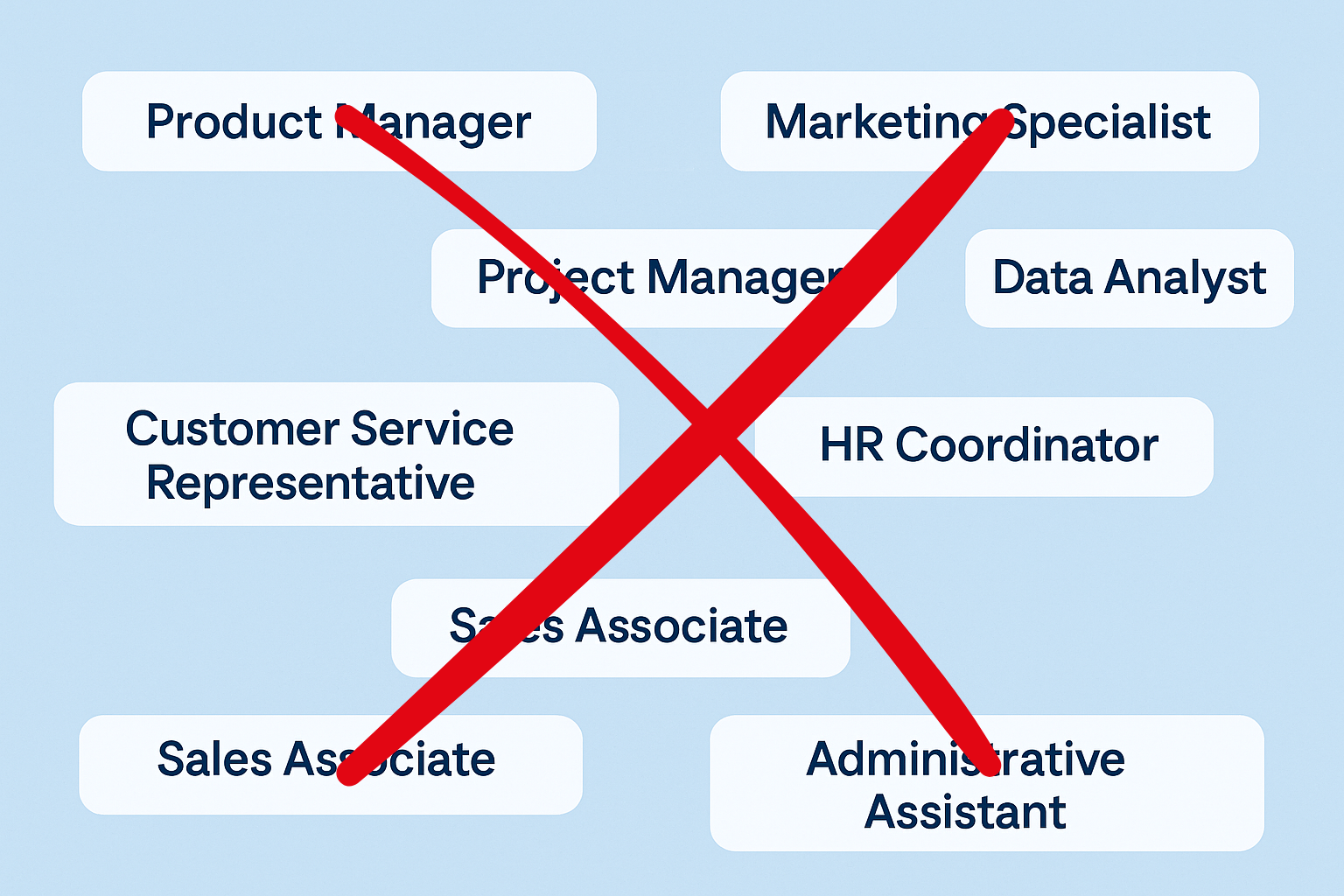
Recently, a business column made an unusual observation - several Fortune 500 companies quietly removed 40+ job titles from their internal systems. Titles such as “Coordinator,” “Associate,” and “Specialist” vanished and were replaced by project-based skill clusters and output expectations. The journalist wrote, “Companies are not losing job titles, they are shedding their old identities.” Source: Financial Times. Initially, it sounded like a unique and creative corporate experiment. However, when analysts from Deloitte noted that nearly 60 percent of organisations plan to redesign roles around skills rather than titles by 2026, the trend became harder to ignore. Furthermore, LinkedIn added its own data point: job posts that describe skills instead of job titles receive 29 percent more applications. Suddenly, a pattern appeared. Job titles are weak and wobbling, and 2026 might be the year they fall. Welcome to the era of skills, outputs, and micro-roles. Job titles used to offer clarity. If someone said they were a “Project Manager,” you roughly knew what they did. Today, a Project Manager might run six workflows, write SQL queries, run stakeholder reviews, manage vendor budgets, and host a Friday call that mysteriously turns into group therapy. Titles have stopped matching reality. Work is redefined. AI automates some tasks, teams work on others, and employees routinely stretch far beyond their title. Harvard Business Review reported that more than 70 percent of workers perform responsibilities outside their official job description. This creates a strange mismatch: employees are evaluated on tasks they were never formally hired to do. The overstuffed job title is collapsing under its own weight. Micro-roles are not official positions. They are high-resolution slices of work. Someone might be a Product Analyst by title but carry micro-roles such as: Each micro-role reflects a skill or output, not a job identity. In scheduling and staffing, micro-roles fix a long-standing problem: organisations historically hired broad job titles even when the actual need was narrow. For example, a hospital might hire an “IT Specialist” when what it truly needed was a credentialing workflow builder and a troubleshooting coordinator. In other words, the world hired umbrellas when it needed laser pointers. Picture a candidate named Maya. Her job title is “Operations Associate.” That tells you almost nothing. But her micro-roles tell you everything. She boosts workflow efficiency, updates Excel dashboards with alarming speed, mediates team disputes, and trains new hires. If you hire according to her title, you will misplace her. Job titles hide what people can do. Skills reveal it. A multi-country survey by McKinsey found that 87 percent of employers now face skill gaps or expect them within two years. As gaps widen, organisations are realising that titles do not solve staffing challenges. Skills do. Outputs go even deeper. Outputs are what a person produces, not what they are called. A strong job title can hide a weak output pattern. A simple output metric can expose it instantly. For example: Outputs remove the fog. Titles bring the fog back. Three forces collide next year: Workforce reports show that skill needs are evolving faster than hiring models. Traditional titles cannot keep up. When you must justify pay bands publicly, skills and output become safer anchors than titles. A survey by ADP found that over half of workers believe their job title does not reflect their real contribution. When the title does not match the work, loyalty falls. Here is how organisations will hire in 2026: This will lead to better clarity, stronger retention, and fewer mismatches. Staffing agencies that continue to source by job title will fall behind. Titles no longer predict performance, longevity, or cultural contribution. Clients want hiring clarity. Candidates want identity honesty. Skill-based staffing delivers both. Systemart helps organisations move from title-based hiring to contribution-based staffing. We translate your workforce needs into: This creates stronger matches, smoother onboarding, and better long-term outcomes. Not because the title is right, but because the work finally fits the worker. Job titles will not disappear overnight. They will just stop being the centre of the hiring universe. The world is moving toward clarity, precision, and contribution. Skills tell us how people work. Outputs tell us what they create. Micro-roles tell us who they really are. In 2026, the companies that win will not ask, “What is the title we need?” That question has no title.Why Job Titles Are Losing Power
The Rise of Micro-Roles
A Small Story
If you hire according to her micro-roles, you will use her correctly.
Why Skills and Outputs Are Becoming the Real Currency
Why 2026 Makes This Shift Urgent
1. The skills shortage is no longer a shortage. It is a structural gap.
2. Pay transparency laws are pushing employers toward skill-based compensation.
3. Employees are rejecting identity labels.
The New Hiring Formula
Not generic responsibilities. Real slices of work.
Not “communication.” Something like “navigates conflict between teams without escalation.”
Outputs tell candidates exactly how performance will be measured.
The title becomes a label, not the definition.What This Means for Staffing Firms
Where Systemart Fits In
A Closing Thought
They will ask, “What is the work we must achieve, and who can truly achieve it?”
But it has an answer.
The End of Job Titles: Why Skills, Outputs, and Micro-Roles Will Replace Traditional Hiring in 2026
|
8 December 2025
Recent Articles

17-Nov-2025
Hiring For Energy And Outcomes Over Culture F...
This week a headline made the rounds in HR circles: companies are retiring “culture fit” and switching to “culture add.” Their argument is, hi...

23-Oct-2025
Hiring Psychology: The Hidden Science Behind ...
Resumes are clean. They show skills, degrees, and sometimes a hobby like “loves hiking.” What they rarely tell you is whether that candidate will ...

13-Oct-2025
When Recruiters Get a Digital Twin: How LLM A...
In a year when headlines are filled with nurse strikes, labor watchdog warnings, and hospitals closing beds due to shortages, it might sound unbelieva...